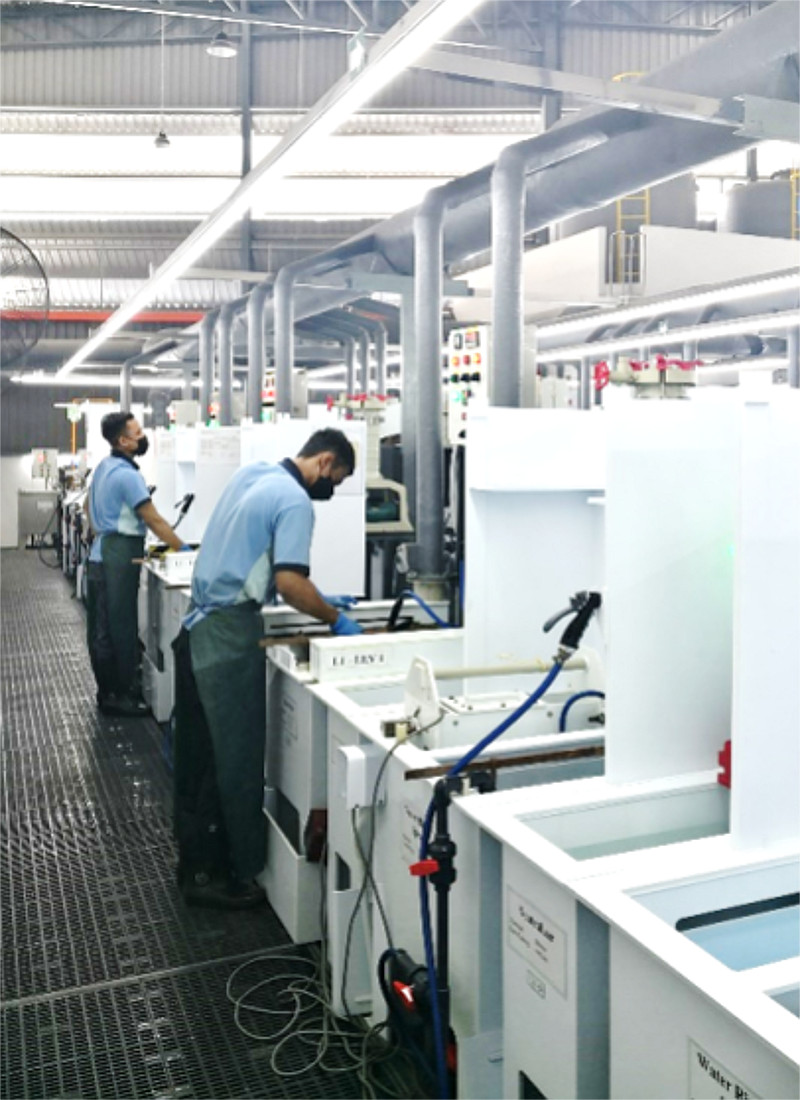
Precision Plating
Precision Plating
Also known as electrolytic plating, this plating method uses electrolytic to make the process occur.
The part to be coated acts as the cathode (negative electrode), while the anode (positive electrode) is usually either a
block of a metal or some conductive material. Chemical solutions (electrolytic) used as the medium in which the electric
current transfer positive and negative ions turning metal ion into solid metal deposit on the parts to be plated.
We are able to comply with the following specifications / standards :-
| # | Process | Specification | Method |
|---|---|---|---|
| i | Precision Plating | Rack / Barrel | |
| a) Flash Gold | Various | Rack / Barrel | |
| b) Soft Gold | MIL-G-45204, Type III, Grade A | Rack / Barrel | |
| c) Medium Hard Gold | MIL-G-45204, Type I, Grade A, B, or C | Rack / Barrel | |
| d) Hard Gold | MIL-G-45204, Type II, Grade B, C, or D | Rack / Barrel | |
| e) Silver | QQ-S-365: Type II (Semi Bright), Type III (Bright) | Rack / Barrel | |
| f) Nickel | QQ-N-290A; ASTM B689 (Type 2) | Rack / Barrel | |
| g) Ni Sulphamate | MIL-P-27418; ASTM B689 (Type 1) | Rack / Barrel | |
| ii | Bright Ni | QQ-N-290A; ASTM B689 (Type 2) | Rack / Barrel |
| iii | Matte Tin Plate | MIL-T-10272 & ASTM B545 | Rack / Barrel |
| iv | Bright Cu | MIL-C14550B | Rack / Barrel |